|
Who
was Tutankhamun?
Tutankhamun
was born around the year 1345. He was first known as Tutankhaten
which means 'living image of Aten'. It is believed he may have
been the son of the Pharaoh Akhenaten. Tutankhamun became
Pharaoh at the age of 8 or 9. He ruled for just 9 years before
his death at the age of about 17. Nothing of great importance
was achieved during his reign. It was the discovery of
Tutankhamun's tomb, filled with fabulous treasures, that has
lead to his fame.
How
was the tomb of Tutankhamun discovered?
In 1906
an archeologist by the name of Theodore Davis found some pottery
jars, bundles of linen and floral collars in the Valley of the
Kings that were inscribed with the name Tutankhamun. These
proved to be funeral items suggesting the existence of his tomb.
However, after some years of unsuccessful searching Davis
decided there was nothing left to be found. Another
archeologist, Howard Carter, did not share these views. He was
convinced the tomb was still there to be discovered and so,
funded by Lord Carnarvon, he continued to search.
Every
summer Carter would meet with Lord Carnarvon to discuss the next
season's work. To his disappointment, in the summer of 1922 he
was told that he was not finding enough and that no more money
would be given. After some persuasion, the Earl gave in and
agreed to finance one more season.
Excavations
began around the tomb of Ramesses VI. Just a few days later some
ancient workmen's houses were found. On 4th November 1922 the
first of these houses was removed to reveal a step. Gradually a
flight of steps was cleared at the bottom of which stood a
sealed door. On this door was the cartouche of Tutankhamun. The
tomb had been found.
As soon
as Carter realised what he had found he sent for Lord Carnarvon
to join him. On Saturday 25th November the door to the tomb was
opened.
What
was found inside Tutankhamun's tomb?
Beyond the door
to the tomb was a corridor filled with rubble, whole
and broken alabaster jars and vases. There was also evidence of
a tunnel suggesting that the tomb had been robbed. At the
end of the corridor they found another sealed door, almost
identical to the first. An iron rod was used to make a small
hole in the door and a candle was used to test for dangerous
gasses. The hole was then widened and Carter used the candle to
look through.
I inserted the
candle and peered in, Lord Carnarvon, Lady Evelyn and
Callender standing anxiously beside me to hear the verdict. At
first I could see nothing, the hot air escaping from the
chamber causing the candle flame to flicker, but presently, as
my eyes grew accustomed to the light, details of the room
within emerged slowly from the mist, strange animals, statues
and gold - everywhere the glint of gold...
When
asked by Lord Carnarvon if he could see anything, Carter replied,
"Yes, wonderful things."
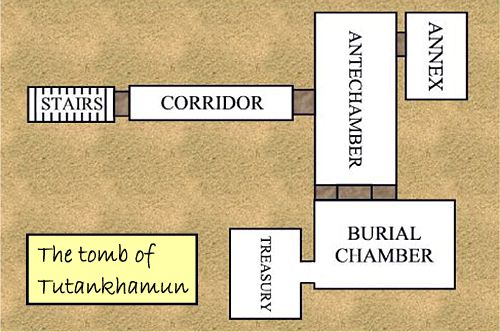
A plan of the tomb of Tutankhamun. Click on the
rooms for more information.
The first
room entered became known as the antechamber.
Amongst other treasures, it contained huge animal couches,
beautifully carved furniture, dismantled chariots and
Tutankhamun's famous golden throne. At the northern end was a
sealed doorway guarded by two wooden statues of the king.
The burial
chamber contained a large, golden shrine that left little
room for anything else. The shrine was unsealed suggesting,
perhaps, that it had once been opened by tomb robbers. A door at
the eastern end of the shrine was unbolted to reveal a second shrine with its seal
intact. Various items, wrapped in linen, had been placed between
the two shrines. Within the second shrine stood a third and this
contained yet another shrine, each decorated with funeral scenes, gods
and goddesses and spells from the Book of the
Dead. Inside the
final shrine stood a stone sarcophagus with winged goddesses
sculpted into each corner.
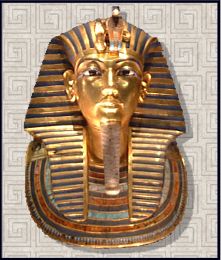 The
sarcophagus was opened to reveal a coffin in the form of the boy
king. At its head, hooked over the carvings of a cobra and a
vulture, lay a small wreath of flowers. Carter believed these
may have been the last farewell offering of Ankhsenamun,
Tutankhamun's young wife. Inside was a second coffin, the facial
features of which were quite different from the first. It is
believed this coffin was not originally intended for Tutankhamun
but was used because of the unexpected timing of his death. A
third coffin, of solid gold, was contained within the second and
finally, within this, lay the mummified remains of Tutankhamun,
his head and shoulders covered with the now famous death mask. The
sarcophagus was opened to reveal a coffin in the form of the boy
king. At its head, hooked over the carvings of a cobra and a
vulture, lay a small wreath of flowers. Carter believed these
may have been the last farewell offering of Ankhsenamun,
Tutankhamun's young wife. Inside was a second coffin, the facial
features of which were quite different from the first. It is
believed this coffin was not originally intended for Tutankhamun
but was used because of the unexpected timing of his death. A
third coffin, of solid gold, was contained within the second and
finally, within this, lay the mummified remains of Tutankhamun,
his head and shoulders covered with the now famous death mask.
The annex
contained some of the everyday items that would have been used
during the reign of Tutankhamun. These included chairs, stools,
baskets, toys, pots, bedsteads, bows and arrows and shields. One
of the more interesting items found here was the board for a
game called Senet.
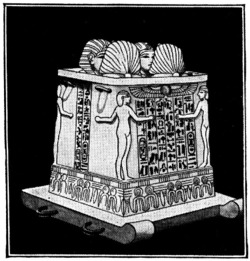 At
the entrance to the treasury stood a statue of Anubis,
jackal-headed god of the dead. Beyond Anubis was a shrine inside
of which stood a canopic chest containing the four canopic jars
(right). There were model boats, jewellery and golden statues.
Wooden boxes contained shawabti figures that were believed to be
servants in the afterlife. Also found in the treasury were the
mummified remains of two foetuses, believed to be the stillborn
daughters of Tutankhamun and Ankhesenamun. At
the entrance to the treasury stood a statue of Anubis,
jackal-headed god of the dead. Beyond Anubis was a shrine inside
of which stood a canopic chest containing the four canopic jars
(right). There were model boats, jewellery and golden statues.
Wooden boxes contained shawabti figures that were believed to be
servants in the afterlife. Also found in the treasury were the
mummified remains of two foetuses, believed to be the stillborn
daughters of Tutankhamun and Ankhesenamun.
Was
Tutankhamun murdered?
In
1968, whilst carrying out x-rays of Tutankhamun's mummy, a
scientist discovered evidence of a serious injury to the back of
the skull. A number of theories have been put forward to suggest
how Tutankhamun received this injury, one of which involved
murder. If Tutankhamun was murdered, one suspect would be Ay
who, following the death of the young king, forced the widowed
queen to marry him so that he could gain power. Another possible
murderer was Horemheb.
Horemheb was a high official who, while Tutankhamun was still a
boy, carried out much of the important decision-making. As
Tutankhamun grew older and became more involved in running the
country, Horemheb became less powerful.
|
Some of the artwork used on this site has been
adapted with permission from Ancient Egypt
- A Resource Center for Ancient Egypt. We have also used artwork
licensed to us by Clipart.com. |
|

